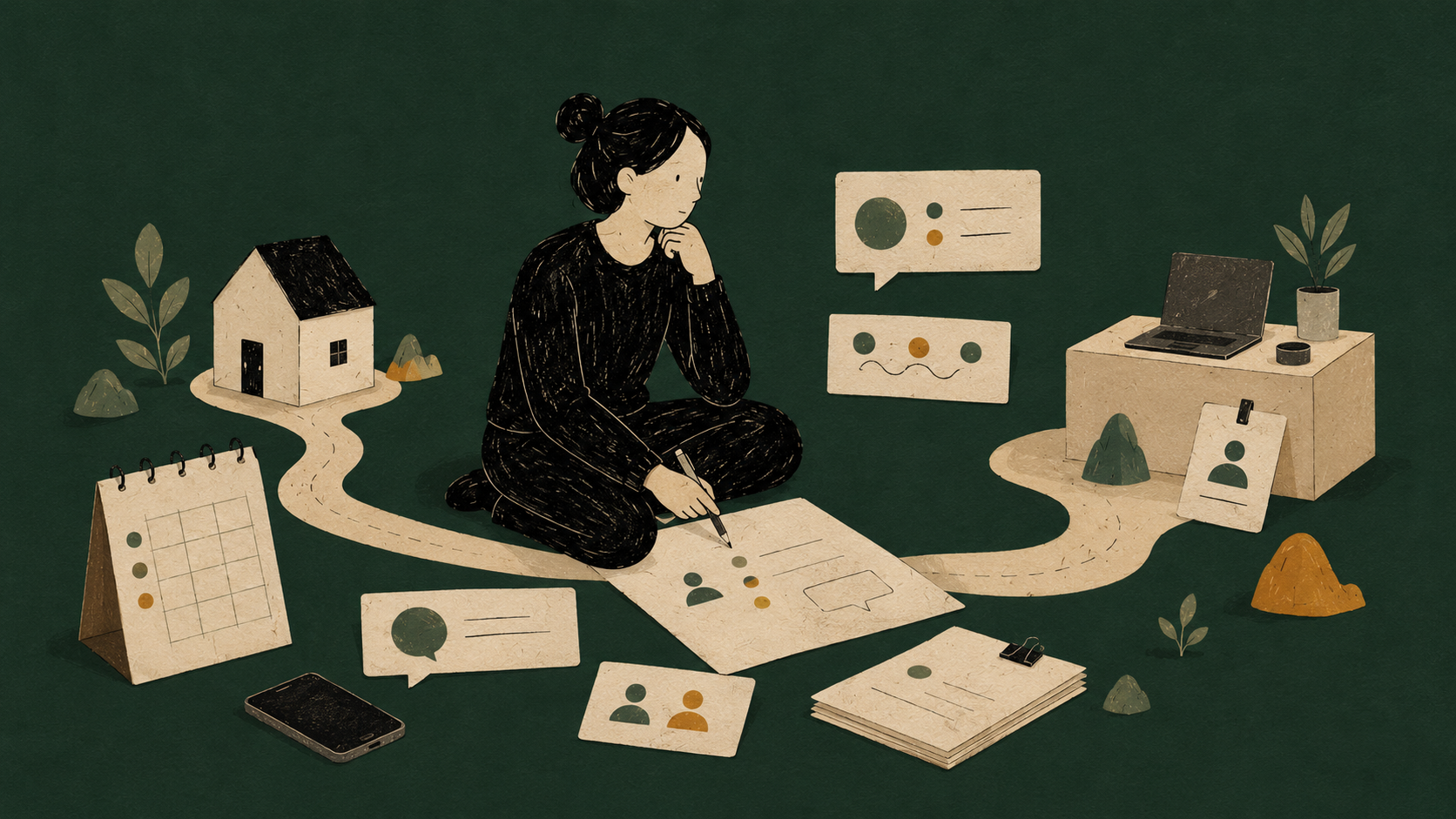
Someone asks what you do on weekends. Not your ex, not your lawyer — a person at work, or someone you've just met. And you pause. Because the honest answer is that you don't quite know yet. The old answer — the one that involved a shared life, a routine you'd built over years, a role that was partly husband and partly father and partly the shape of someone else's life — doesn't fit anymore. And the new answer isn't clear yet.
This pause shows up around month three. Sometimes later. The Survive phase keeps you too busy to notice it earlier. But once the immediate fires are out and the schedule is running and the flat is set up, it surfaces. Quietly, then insistently.
Who are you now?
This isn't a therapy question. It's a practical one. And it has a practical answer — not a tidy one, but something you can actually work with.
Why it hits later, not at the start
In the first weeks, identity isn't the problem. Survival is the problem. You're sorting bank accounts and parenting schedules and where to sleep. The urgency is external. It keeps you oriented.
The identity question arrives when the urgency fades. When there's no longer a list to get through and the structure is working and the kids are settled — or settled enough. The silence that follows is where you find out how much of your sense of self was built into the relationship.
For most people who've been in a long relationship, the answer is: more than they expected. Not because the relationship was consuming, necessarily, but because identity drifts slowly and invisibly over time. Interests become shared interests. Friends become couple friends. Weekends take the shape of two people's preferences rather than one. Ambitions get adjusted to fit the architecture of a shared life.
None of that is wrong. But when the architecture comes down, you're standing in a cleared space asking what was actually yours.
What got dropped
Start here. Not with what you want to build — with what you stopped doing.
Most people in long relationships can identify two or three things they gave up without a clear decision to give them up. A sport or physical pursuit that got deprioritised. A creative interest that seemed indulgent once the kids arrived. A set of friendships that drifted. A career ambition that got quietly filed away. An aspect of yourself — the reader, the musician, the person who used to travel without a plan — that stopped being part of the daily story.
These aren't always recoverable. Sometimes you stopped because you grew out of it, not because the relationship required it. But many of them are sitting there, still available, waiting for you to decide whether you want them back.
Write the list. Literally — on paper or in a note. What did you stop doing? What did you stop being? Not what you lost in the separation. What you lost earlier, during the relationship, that the separation hasn't taken from you.
That list is your first resource.
Reclaiming versus rebuilding
These are different things and the distinction is worth making clearly.
Reclaiming is going back to something that was yours. The sport, the instrument, the friendship, the habit. It feels familiar when you return to it. It slots back in. This is the easier path and a legitimate one — there's nothing regressive about recovering yourself.
Rebuilding is constructing something new. A different physical discipline, a new set of interests, a version of yourself that didn't exist before the relationship or during it. This is slower, more uncertain, and often where people get stuck — trying to build something new when they haven't yet recovered what was theirs to begin with.
The mistake most men make in this period is trying to rebuild before they've reclaimed. They want the new chapter before they've finished accounting for the old one. The result is either a false start — an identity adopted quickly and discarded — or a drift, where the new self is assembled by default from whatever happens to be available.
Reclaim first. Then rebuild from a more solid base.
Two questions worth sitting with
Not in a journalling sense — just as questions to carry around for a week or two and see what they surface.
The first: what would you spend your time on if nobody was watching and nothing was strategic? Not what you should do. What you'd actually reach for on a Tuesday evening with a free hour. The answer is often closer to the truth than what you'd say in a job interview or to a first date.
The second: what do you want to be true about your life in five years that isn't true now? Not where you want to live or what you want to earn — what you want to be true about who you are. Fitter. Calmer. Closer to your kids. Better at something. Back in contact with yourself in some way you've lost.
Both questions point at the same thing: the gap between the self you've been running and the self you'd choose. Separation is genuinely one of the few circumstances in adult life where that gap can be meaningfully closed — not because the separation is good, but because the architecture has come down and you get to decide what to build.
If you are trying to understand where this identity shift sits in the bigger arc, read the four phases guide.
The exercise
Not a reflection. An action.
Pick one thing from the "what got dropped" list. One specific thing. Book it, register for it, message the person, buy the equipment, set the time. Do it this week, not this month.
Not because it will fix anything. Because it signals — to yourself, concretely — that you're not waiting for the new identity to arrive. You're constructing it, one small choice at a time.
That's how it works. Slowly, then less slowly. Reclaim one thing. Then another. The question of who you are now gets answered by what you do, not by what you decide you want to be.
One caveat: if the identity question tips from curiosity into hopelessness — if it's not "who am I now?" but "what's the point?" — don't turn it into a productivity project. That's a different thing, and it needs a different response. Talk to someone properly: your GP, a therapist, or someone you actually trust. The exercise above is for people who feel lost. It's not for people who feel done.
Start there.
Turn the two questions into one practical next step in Atlas Goals tool.