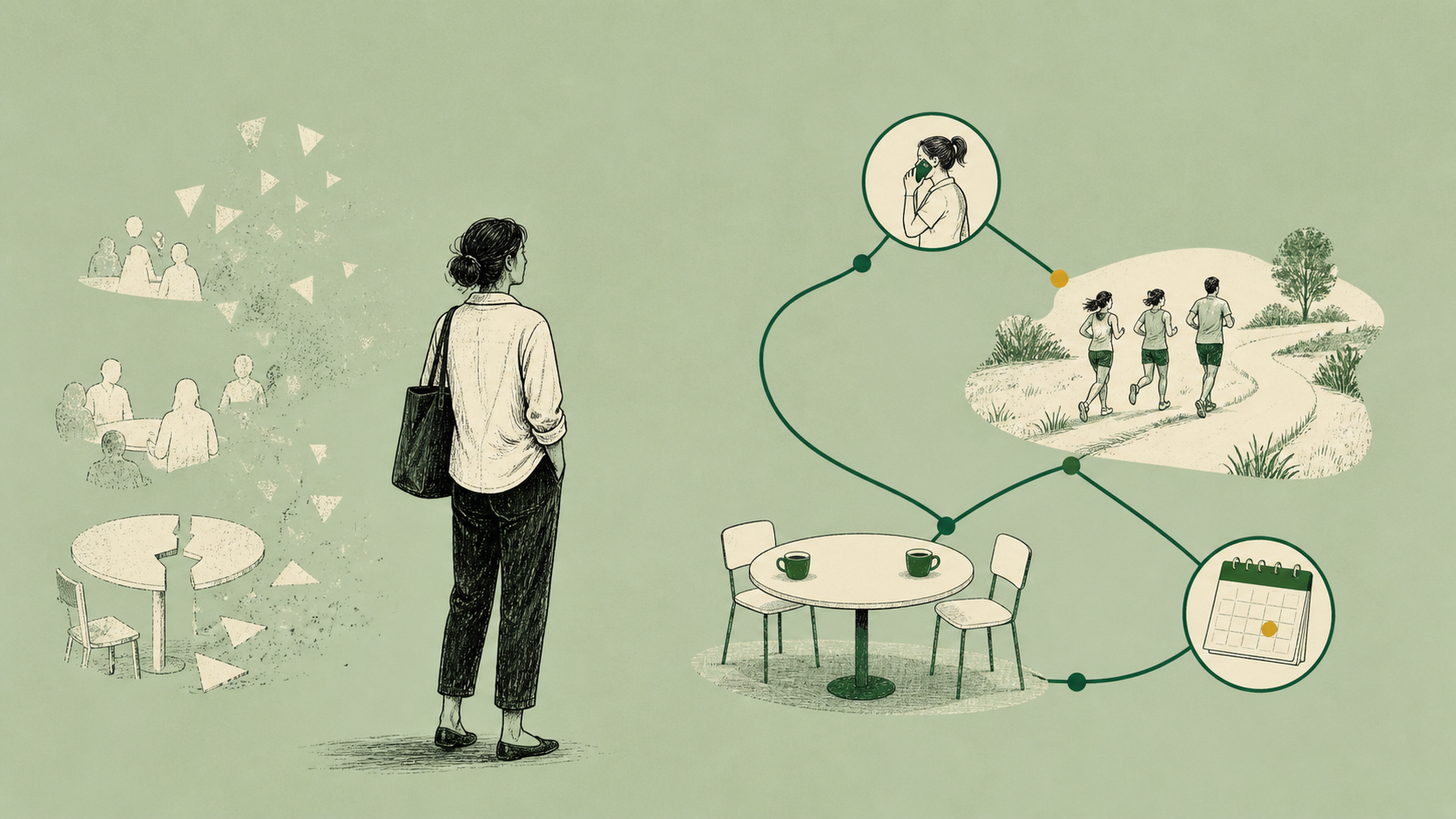
About three months in, you'll notice it. Not the big absence — you've been managing that. The smaller one. The Saturday afternoon that used to have a shape and now doesn't. The group chat that went quiet. The couple you used to see every few weeks who've sent one vague "we should catch up" text and haven't followed through.
Your social infrastructure didn't just shrink. Parts of it are gone. And the advice you'll read — "lean on your support network," "build your community" — will feel useless because it assumes you have one to lean on.
This is the part nobody warns you about. Here's what actually happens, and what to do about it.
Why men's social networks collapse faster
When a marriage or long-term relationship ends, both people lose things socially. But they don't lose them equally.
In many long-term relationships, the social logistics have been carried unevenly. Dinners organised, birthdays remembered, weekend plans made. When the relationship ends, those logistics often disappear too — and so do the friendships that depended on them.
You saw those people because someone organised the dinner. You caught up with that friend because you were both at the same birthday. You stayed connected to that group because of the shared routine of the relationship. Without the logistics, a lot of friendships — even ones that felt solid — quietly lapse.
This isn't a character flaw. It's what happens when the infrastructure goes. It's also something you can do something about, once you understand it.
The couple-friends problem
Most of your couple friends will drift toward her. Not maliciously — logistically. If the children are primarily with her during the week, the school-gate conversations happen with her. The friendships that were maintained through weekend plans involving kids default to the easier arrangement.
Some couple friends will make a genuine effort to maintain both relationships. Most will pick one, consciously or not. The ones who were primarily her friends before you became a couple will go quickly. The ones who were primarily yours may stay — or may find that a separated man doesn't fit the social architecture of their life as easily.
Don't try to hold onto couple friendships that are drifting. The effort is usually asymmetric and the outcome rarely matches the energy. Let them go gracefully. The ones that survive without effort are the ones worth keeping.
Support contact versus actual friend
There's a difference, and in the first year it's worth being clear about it.
A support contact is someone who knows you're going through it and is available when things get hard. This is valuable. A therapist, a brother, a mate who's been through it himself. You need at least one person in this category.
An actual friend is something different — someone you talk to about ordinary things, not just the separation. Football, work, what you've been watching, something that made you laugh. Someone who treats you like a person, not a crisis.
What men in early separation most often lack isn't support contacts. It's ordinary friendship — the low-stakes, no-agenda kind. And that's the gap that does the slow, invisible damage over months.
Both matter. They're not the same thing.
How to rebuild without it being awkward
Most advice about rebuilding a social life after separation falls into two categories: therapy-speak ("be vulnerable, reach out") or generic lifestyle content ("try a new hobby"). Neither is particularly useful for a separated dad with limited time and limited energy.
Here's what actually works.
Reconnect with one person from before the relationship. Not someone from your shared social life — someone from before. An old friend, a uni mate, a former colleague. Someone who knew you as an individual, not as half of a couple. Send a direct message. Not "we should catch up sometime" — that's not a plan. Name a day and a thing. Midweek beer, a run, coffee on a Saturday morning. One specific ask.
Find one thing that gets you around people without the social performance of it. A running group, a team sport, a gym class you go to consistently, a music lesson. The goal isn't to make friends from it immediately. The goal is to have a regular context where you're around people without it being a social event. Relationships build slowly out of repeated low-pressure contact.
Create one recurring slot. Not a big event. A small standing commitment — monthly dinner with one or two people, a weekly call with someone who matters. Recurring beats one-off. One-off plans get cancelled. Standing commitments hold.
Use Atlas Goals tool to set one small social rebuild goal for the next seven days.
The one-conversation rule
In the structure piece, I mentioned one real conversation per week as a structural anchor. That's not aspirational — it's the floor.
One conversation that isn't about logistics, legal proceedings, or the kids. A conversation where you're a person, not a situation. It can be fifteen minutes on the phone. It can be a walk. It doesn't have to be heavy.
The social isolation that damages separated men isn't usually dramatic. It's the slow accumulation of weeks where every interaction is functional — co-parenting, work, admin — and nothing is just human. That's the thing to protect against.
You're not building a social life in the first year. You're maintaining enough of one to stay functional. Pick one person this week. Reach out with a specific plan. That's the start.
If this is part of a bigger identity wobble, read Who are you now? next.