Quick answer
If you have a joint mortgage, both borrowers are usually responsible to the lender for the loan, even if one person moved out.
The practical question is different:
- Who can actually pay it this month?
- What interim agreement can you document?
- Will payments be treated as contributions later?
- Does the property need to be sold, refinanced or temporarily held?
- What happens if one person stops paying?
Do not solve the property settlement in your head. First, solve the next repayment.
The repayment does not pause because the relationship did
The bank does not care who sleeps in the main bedroom now.
The repayment lands. The redraw has a number. The offset has a number. The person still living in the house has groceries. The person who moved out has rent, bond and a bed frame from Facebook Marketplace.
This is where separation gets financially weird.
You can be legally connected to a house you no longer live in. You can be paying rent and mortgage at the same time. You can be told “it will all be sorted in settlement” while the next payment is due on Friday.
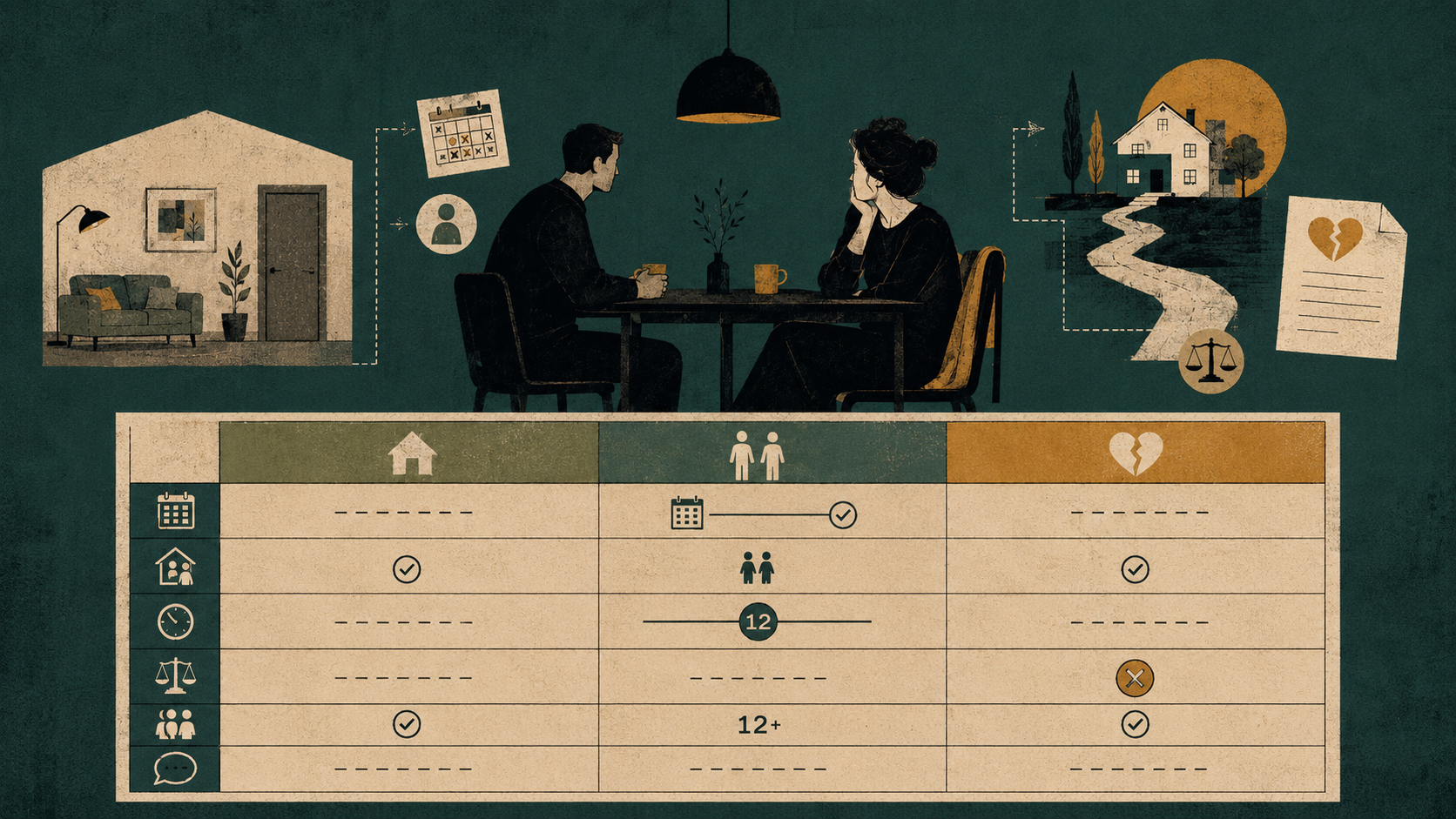
The three common scenarios
Scenario 1: both keep paying the mortgage
This is the cleanest version if both people can afford it.
You agree who pays what, from which account, and for how long. Then you document it.
Do not rely on “we both know what we said.” In separation, memory becomes a creative writing department.
Scenario 2: one person pays while living in the home
This is common.
One person stays in the home and pays the mortgage. The other pays rent elsewhere. Those payments may later be relevant as financial contributions or practical living costs when property settlement is negotiated.
Read what happens to the family home when you separate for the bigger buyout, sale and deferred-sale question.
Scenario 3: one person cannot or will not pay
This is the dangerous one.
A joint loan means the lender can usually chase both borrowers. If the repayment is missed, both credit files may be at risk. Even if your ex promised to pay “their half”, the bank may still see the full debt as a shared obligation.
Call the lender early if the payment is at risk. Ask about hardship options. Get names, dates and reference numbers.
The interim agreement matters
Before property settlement is final, you need an interim mortgage agreement.
It can be simple:
- who pays the mortgage
- who pays rates, strata, insurance and utilities
- whether payments are shared 50/50 or in another ratio
- whether the arrangement is temporary
- whether either person is reimbursed later
- what happens if the house is listed for sale
- what happens if refinancing is attempted
You may still need legal advice. But even before legal advice, write the facts down.
For the broader property framework, read property settlement after separation.
The cash-flow test
Open Atlas Finances and model three versions:
- Hold: both keep paying until settlement.
- One pays: one person pays the mortgage while the other pays rent.
- Exit: the home is sold or refinanced as soon as possible.
Put the actual numbers in:
- mortgage repayment
- rent
- council rates
- strata
- insurance
- utilities
- maintenance
- child support
- school costs
- legal costs
The answer may be ugly. Good. Ugly is data.
Watch the offset and redraw
Offset and redraw accounts can become quiet battlegrounds.
Write down:
- balance at separation
- withdrawals after separation
- who made them
- what they were used for
- whether both people agreed
Take screenshots and save statements. Not to be dramatic. To avoid archaeology later.
Common mistakes
Mistake 1: assuming moving out removes mortgage responsibility
It usually does not. If your name is on the loan, treat the debt as live until the bank releases you or the loan is paid out.
Mistake 2: letting one person control all information
Both people on the loan should be able to see statements and repayment status. If you cannot access the information, fix that quickly.
Mistake 3: agreeing verbally
A text message is not a perfect legal document. It is still better than “we talked about it in the kitchen.”
Mistake 4: waiting until default
Talk to the lender before the missed payment, not after the third angry letter.
A simple mortgage record
Keep a running note:
- date
- repayment amount
- who paid
- account used
- what was agreed
- related bills paid
- lender conversations
- hardship references
- sale or refinance steps
Use Atlas Admin for the record and Atlas Finances for the cash flow.
The settlement may take months. The mortgage will not wait that politely.
Sources and resources
Last checked: 20 May 2026.
This article is general information, not legal, financial or medical advice. Check the current rules before acting on anything money, court or health related. If there is family violence, coercive control, risk to children, urgent housing risk or court orders in place, get professional advice before relying on a checklist.
- https://www.legalaid.nsw.gov.au/ways-to-get-help/publications-and-resources/mortgage-problems-due-to-partner-separation
- https://moneysmart.gov.au/family-and-relationships/getting-divorced-or-separating
- https://moneysmart.gov.au/managing-debt/financial-hardship
- https://ndh.org.au/
- https://www.legalaid.nsw.gov.au/my-problem-is-about/my-family-or-relationship/finance-and-property/finances-and-property-after-separation
- https://www.familyrelationships.gov.au/separation/money-property