Most co-parenting advice assumes a baseline of goodwill. Two adults who have parted ways but can still have a civil conversation about school pick-up times and after-school activities. Two people who disagree sometimes but generally want the same thing for their children.
That's not every situation. Sometimes the person you're co-parenting with is someone you don't trust — because of what happened during the relationship, because of how the separation has unfolded, or because of ongoing behaviour that gives you genuine cause for concern. The children still need a functioning arrangement. The question is how to build one when goodwill is not the foundation.
This is a guide for that situation.
The shift that makes everything else possible
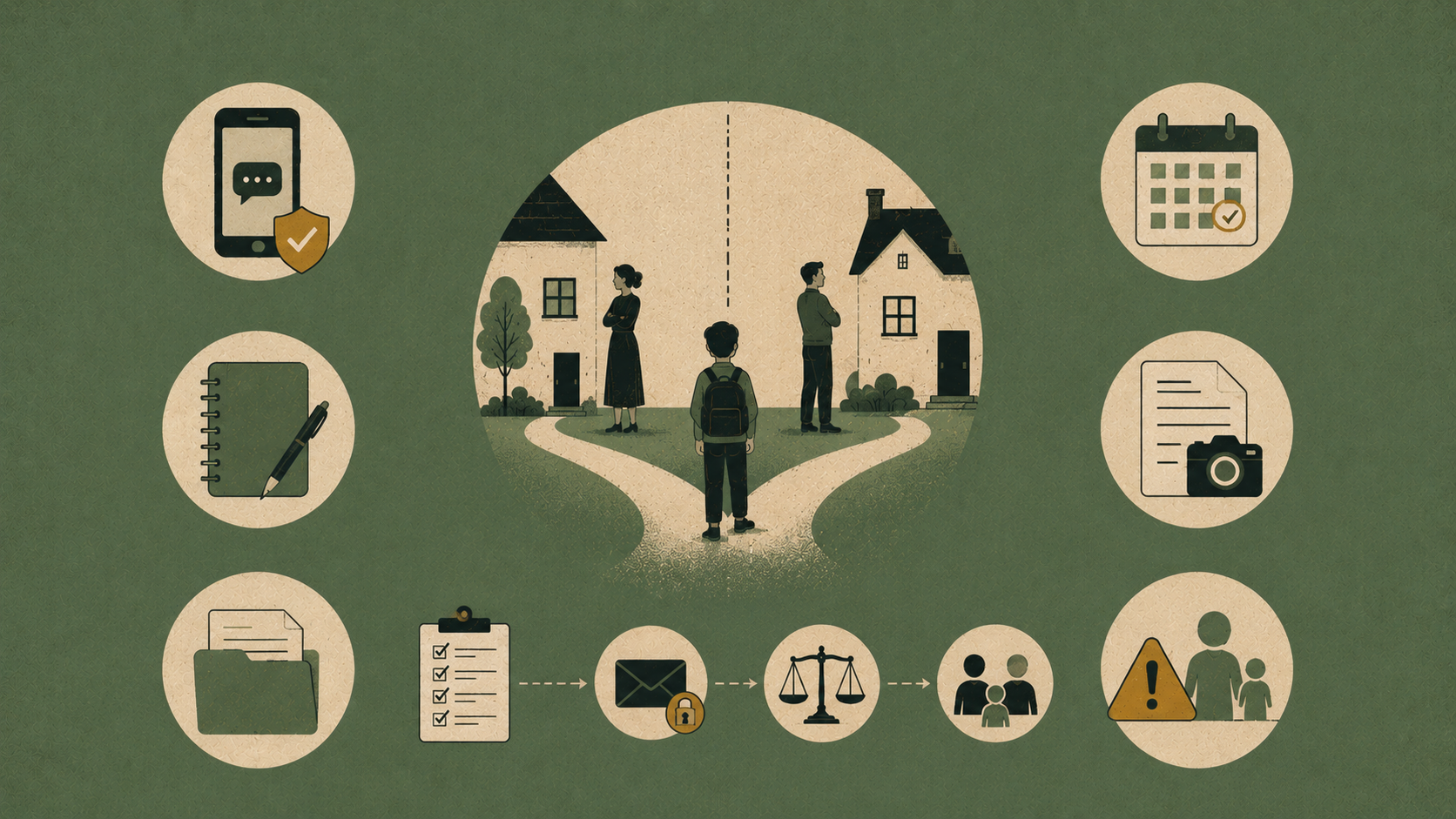
High-conflict or low-trust co-parenting works on one principle: minimise direct contact, maximise documentation.
Fewer live conversations means fewer escalations. Written communication means a record of what was said and agreed. A clear structure means less room for dispute about who said what. None of this is about punishing your ex or protecting yourself at all costs — it's about building a system that runs on rules rather than relationship, because the relationship isn't reliable.
This is not the parenting dynamic you'd choose. It is often the one that produces the most stability for children when the alternative is ongoing conflict in the room.
Communication: switch to written only
If at all possible, move all co-parenting communication to written format.
Text is functional for simple, immediate things. For anything significant — changes to the schedule, decisions about school or health, requests to vary the arrangements — email or a dedicated co-parenting app is better. There's a clear record, both parties had time to consider their response, and there's no ambiguity about what was said.
OurFamilyWizard is the most widely used co-parenting communication platform in Australia. It logs all messages with timestamps, tracks read receipts, includes a shared calendar and expense tracking, and is admissible in Family Court proceedings. It costs approximately $180 AUD per parent per year. If you have a solicitor, ask whether they recommend it — many do.
TalkingParents is a similar service and is also court-admissible.
Establishing written communication doesn't require your ex's cooperation. You can unilaterally switch to writing — decline phone calls about parenting matters, respond to verbal communication in writing to create a record, send a brief follow-up confirming what was said in any conversation. "Following up on our conversation this morning — I want to confirm that we agreed [X] and that pickup on Friday remains at 5pm."
Documentation: start immediately
If you don't already have a log, start one today.
Your log should record: every significant interaction, every missed pickup or late arrival, every time an agreement was changed without your consent, every concerning statement the children report, every financial transaction related to child support or agreed shared costs.
Brief entries are fine. Date, what happened, what was said, what the outcome was. Keep it factual, not emotional. "14 May — scheduled pickup at 5pm. Ex arrived at 6:20pm. No prior notice given. Children had not eaten." Not: "Ex was late again because she clearly doesn't care about the schedule." The first is evidence. The second is commentary.
This log is a resource, not a weapon. Its purpose is to provide an accurate record if disputes escalate to legal proceedings, to give you clarity about patterns you might not otherwise see, and to protect you if you're accused of something inaccurate.
Use Atlas Admin tool to keep a clean, factual record of key decisions, agreements, missed handovers, and next actions.
The parallel parenting model
Parallel parenting is a framework developed specifically for high-conflict situations. Unlike cooperative co-parenting — where both parents are in regular contact, make decisions jointly, and maintain a working relationship — parallel parenting minimises interaction and creates clearly delineated zones of responsibility.
The idea is that each parent is largely autonomous within their parenting time. Decisions about day-to-day life — what the child eats, when they sleep, what activities they do — belong to whoever has the child. Major decisions — medical, educational, significant financial — are either subject to a prior written agreement or a defined decision-making process that doesn't require ongoing negotiation.
The structure is formalised in a parenting plan or consent orders that are specific enough to reduce the number of decisions requiring contact. The clearer the plan, the fewer the conversations.
This is not the ideal long-term model. Children benefit from parents who can cooperate. But parallel parenting is significantly better than ongoing conflict, and it can be a stable structure for years while the more acute phases of separation settle.
Use Atlas Kids Week tool to reduce avoidable contact by making the schedule, handovers, and recurring rules visible.
What to do when the arrangement isn't being followed
If your ex repeatedly fails to follow the agreed arrangements — missing pickups, withholding children, unilaterally changing terms — the response depends on how the arrangement is documented.
If you have consent orders: non-compliance with court orders is a serious matter. Keep your documentation log. Attempts to resolve the breach directly first (in writing) are generally expected before legal action. If the pattern continues, a family lawyer can advise on contravention applications.
If you have an informal parenting plan or no documented arrangement: the first step is trying to reach a written agreement. If that fails, FDR mediation (with appropriate safety provisions if needed) is the next step. If mediation doesn't resolve it, you can apply to the court for parenting orders — but you'll typically need a Section 60I certificate showing you've attempted FDR first.
Do not withhold your parenting time with the children in retaliation for the other parent's breach. Courts take a dim view of parents who prevent children from spending time with the other parent, even when that parent has behaved poorly. Stick to your arrangements and document the other party's failures.
When there are safety concerns
If you have genuine concerns about the safety of your children in your ex's care — not "I think their routine is different over there" but real concerns about neglect, abuse, exposure to family violence, or substance use — the process is different.
For immediate safety risk: contact the police or child protection services in your state. Do not wait for a parenting hearing.
For ongoing concerns that are serious but not immediate: document everything, seek urgent legal advice, and consider an urgent application to the Family Court for interim orders. Courts can act quickly on applications where child safety is at stake.
Don't conflate genuine safety concerns with disagreements about parenting style. One warrants an urgent legal response. The other is better addressed through the normal parenting plan framework.
Looking after yourself in this
High-conflict co-parenting is exhausting. It requires you to manage your own responses in situations that are genuinely provocative. Over time, living in a defensive posture — documenting, managing communication, anticipating the next conflict — takes a toll.
A few things that matter more than any of the above:
Don't process the conflict with your children. They are not your support system, and using them as one — even subtly — creates damage that takes years to surface.
Find somewhere to actually process it. A therapist, a trusted friend, a GP. Not for indefinite self-analysis — for having a place to put it that isn't your kitchen floor at 11pm.
Pick your battles with genuine deliberateness. Not every variation from the plan is worth a documented letter. Respond to things that actually matter. Let small things go. The ratio of battles fought to battles won determines whether the system is sustainable.
Check out the Atlas Guides tool for practical conversation scripts to talk to your ex.
Sources and further reading
- Family Relationships Online — support for separated parents: familyrelationships.gov.au
- OurFamilyWizard — co-parenting communication app: ourfamilywizard.com
- TalkingParents — court-admissible co-parenting platform: talkingparents.com
- Federal Circuit and Family Court — contravention applications: fcfcoa.gov.au
- 1800RESPECT — national domestic violence and family safety line: 1800 737 732
- Child protection services — contact your state's department (e.g. FACS NSW, DFFH Victoria, Child Safety QLD)