You're standing in an empty flat. Two bedrooms if you were lucky with the budget, one if you weren't. No furniture beyond what you brought in the car. The kids are coming on Friday. It's Tuesday.
The impulse is to fix it all at once — Ikea run, full kitchen kit, something on the walls. That's not the move. The move is to know what actually matters, spend money there first, and leave everything else until you can see it clearly.
This is the practical guide to setting up a place that works on one income, in a rental market that makes no allowances for your situation.
The one-bedroom versus two-bedroom question
Before anything else: do you need a two-bedroom?
The legal answer is nuanced. Courts don't have a hard rule that children must have their own room. What matters — if it ever comes to that — is whether your housing arrangement is appropriate for the care time you're providing. A one-bedroom flat where children sleep on a pull-out sofa for extended overnight stays can be a problem. A one-bedroom with a proper sleeping arrangement for one child, for a reasonable care schedule, is generally fine.
The practical answer depends on your kids' ages, how much time you have them, and what you can actually afford. Two children sharing a room is not a crisis — they did it in the family home in many cases. A teenager sharing a room with a nine-year-old is a different situation to two kids the same age.
If budget forces a one-bedroom: a quality sofa bed or a good fold-out mattress in a dedicated corner matters more than the room configuration. What children remember is not the floor plan. It's whether it felt like somewhere they belonged.
What to buy first
Sequence matters when you're working with limited capital. Most people get this backwards — they buy the things that are visible and defer the things that actually affect how the place functions.
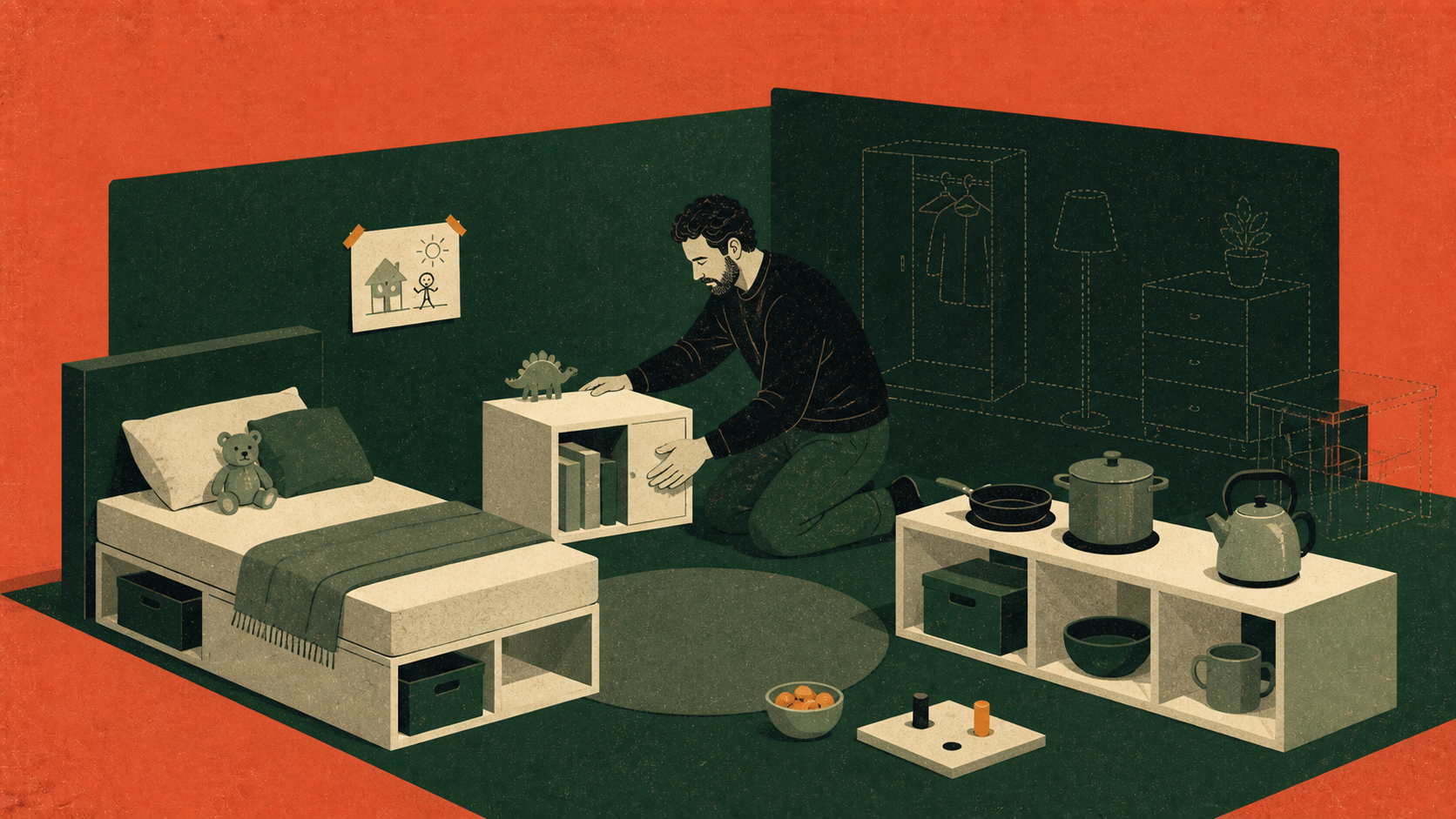
Buy the kids' sleeping situation first. A proper bed, or a quality fold-out — not a camping mat. This is non-negotiable. The message it sends is more important than the cost. Then their bedding, in whatever colours or characters they care about. Let them pick if you can.
Buy your own mattress second. Not a $200 warehouse mattress. Sleep is the single biggest lever on your decision-making, mental health, and energy during this period. Spend what you can reasonably afford here.
Then: kitchen basics that let you cook actual meals. One good pan, one pot, a knife, a chopping board. A kettle. You don't need a full kitchen set — you need the things that make it possible to feed people without ordering Uber Eats every night.
Leave the living room, the decorating, the second lamp, the bookshelf for later. None of it matters yet.
Secondhand versus new — an Australian guide
You're setting up a household from scratch on one income in a rental market that makes no allowances for your situation. In many Australian cities, a two-bedroom place is painfully expensive on a single income. The maths doesn't favour buying new everything.
Facebook Marketplace is the first stop for furniture. Beds, desks, bookshelves, sofas — all available, all heavily discounted, most of it in reasonable condition. Set alerts for your suburb or nearby. Things move fast.
Buy new: the mattress (hygiene, and it will last), the kids' bedding (they care about this and it's not expensive), anything in the kitchen that touches food preparation, and anything that gets daily wear — a desk chair if you work from home, a decent couch if that's where you spend your evenings.
Buy secondhand: dining table, bookshelves, storage, side tables, lamps, outdoor furniture, the second TV if you need one. Ikea is fine for the functional stuff — drawer units, shelving, storage. It's not a permanent home, it's a working one.
Op shops (Vinnies, Salvos, St Vincent de Paul) are underrated for kitchen items, kids' books, and decorative pieces. The Salvos stores in most Australian cities have a consistent turnover of usable household goods at prices that make Marketplace look expensive.
Making it feel like their place too
This is the part that matters most and costs the least.
Give each child one area that is unambiguously theirs. A shelf, a corner, a designated drawer. Something they can leave things in between visits without it being packed away. The psychological weight of that — having somewhere to leave your stuff — is significant for kids moving between two houses.
Let them put something on the wall. A poster, a drawing, a photo. Something that marks the space as theirs. It will survive the end of the rental.
Have something there that isn't at the other house. Not to compete — just to give the place its own identity. A specific snack they like. A game that lives here. A ritual that belongs to this house. These accumulate into the texture of a place feeling like home.
Once the place is functional, build the kids’ weekly rhythm in Atlas Kids Week tool.
The budget reality
As a rough working range, setting up a two-bedroom rental from scratch can easily land somewhere between $3,000 and $6,000 if you buy secondhand strategically and new only where it matters. More if you're furnishing everything new. Less if you bring more from the family home. Costs vary significantly by city and circumstance — the point is to plan for it rather than be surprised by it.
Sequence it over the first two months rather than trying to do it in week one. The first $1,500 covers beds, basic kitchen, and the kids' spaces — everything you need for them to come on Friday. The rest can wait.
Use the Atlas budget tool to track what you're spending against what you have. The two-household cost gap is real and it hits hardest in the first six months when you're setting up from nothing. See the number clearly rather than letting it accumulate invisibly.
The place doesn't need to be finished to feel liveable. It needs to feel safe, functional, and like somewhere the kids belong. That's achievable from week one.
Before you buy everything at once, put the setup costs into Atlas Finances tool and see what the first month can actually carry.