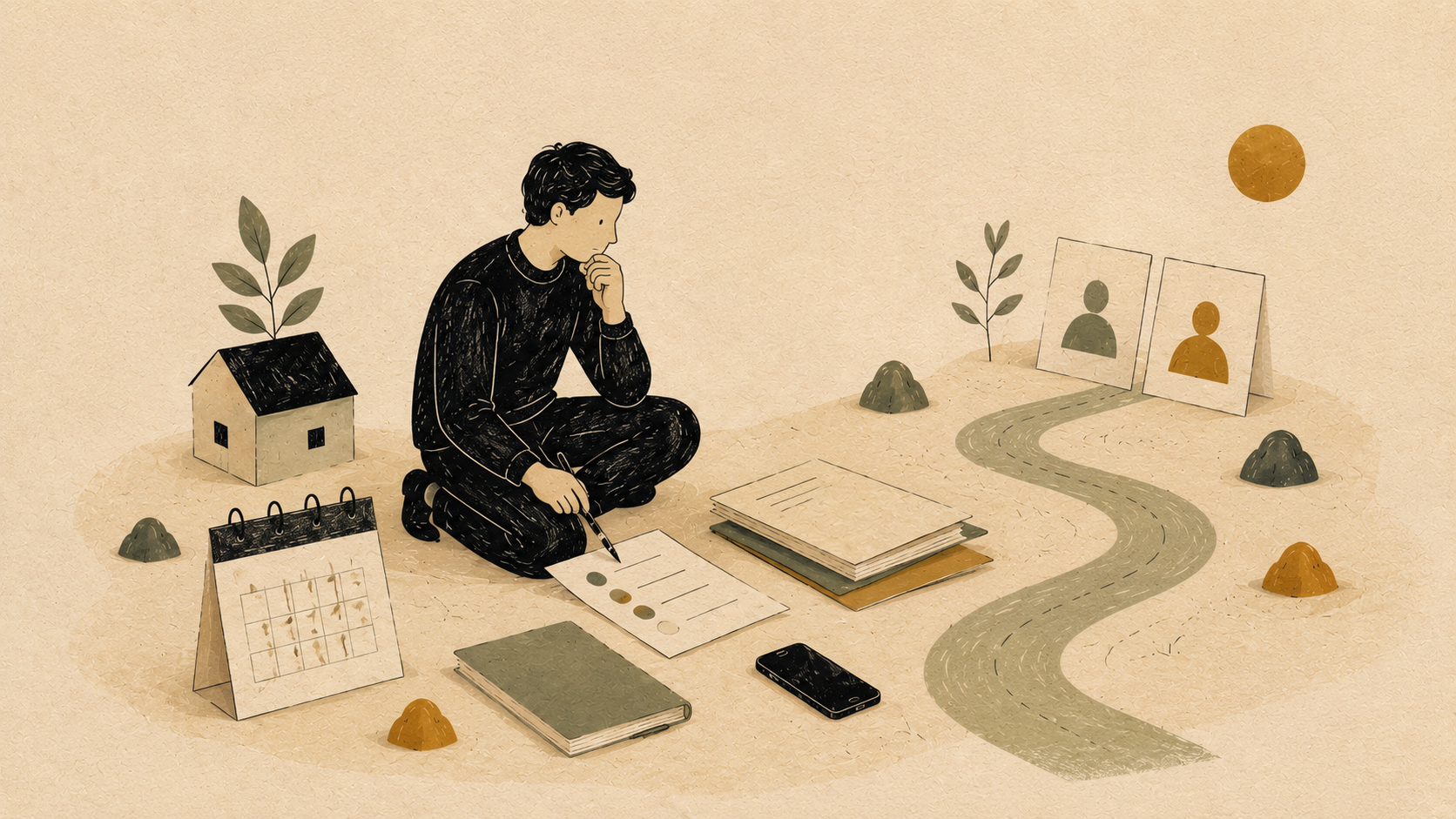
You're sitting at the dinner table. The kids are talking about something from school. Your partner is asking if you remembered to call the plumber. And somewhere behind all of it, quiet and insistent, is the thing you haven't said yet. The calculation you've been running for months. The version of the future you've been sketching in your head at 2am while the person next to you sleeps.
Nobody in that room knows. That's the waiting room.
What it is
The four phases of separation — Survive, Stabilise, Rebuild, New Chapter — describe what happens after the break becomes real. After the conversation, the moving out, the letter from the lawyer. They start at the bottom of the drop.
But the drop doesn't come from nowhere.
For a lot of separations, one person has already left — mentally, emotionally — months or years before anything becomes official. They've run the numbers. They've imagined the logistics. They've had the moment of clarity and the moment of doubt and then the moment of clarity again. They're living in a completely different version of the relationship from the person sitting across from them.
That experience has a name. Call it Phase Zero. The Waiting Room. The pre-separation period that nobody writes about because it's invisible — to everyone except the person inside it.
Start privately with Atlas Finances tool so you can see the numbers without turning the whole house into a courtroom.
What it feels like
Not dramatic. That's the thing people don't expect. The waiting room is mostly quiet.
It's the weight of a decision that hasn't been made yet, or has been made but not said. It's the strange guilt of knowing something the other person doesn't. It's the mental rehearsal of conversations that haven't happened — how you'd say it, when, what they'd say back. It's lying awake doing logistics. The house, the kids' schedule, what separation actually costs, whether you can afford it on one income.
It's also, sometimes, the exhausting effort of maintenance. Keeping the surface intact. Going to birthday parties. Planning a holiday you know you won't go on. Having the "everything's fine" conversation with your parents or your friends because the alternative is too complicated to explain.
Some people stay in the waiting room for a year. Some for longer. A few find their way back out the other side — the relationship changes, or they do, and the decision changes with it. Most don't.
Why the timing is never right
One of the most consistent features of the waiting room is paralysis around when.
Not whether. When. The decision has often already been made. What's left is the problem of the right moment — which never arrives, because there is no right moment to end a family. There's only the moment you choose.
The waiting compounds this. Every week that passes makes the eventual conversation harder to have, not easier. The gap between what's being said and what's being thought gets wider. The person in the waiting room knows more and more, and the other person knows less and less, and the asymmetry builds.
What usually breaks it is a specific trigger — a conversation that goes badly, a realisation about the kids, a moment of honesty that can't be walked back, or simply the accumulated weight of too many dinners where nothing real was said.
What to do if you're here
Not "what to feel." What to do. In order.
See a lawyer once, privately, before anything else. Not to start proceedings — to understand the landscape. What property settlement looks like for your situation. What child support would be assessed at. What the timeline is. Knowing the real shape of what's coming reduces the terror of it. It also stops you making decisions — financial, logistical, conversational — based on assumptions that turn out to be wrong.
Get your financial picture clear. Separately from your partner, understand the full asset position: the joint accounts, the super balances, the mortgage, the debts. Not to act on it yet — to see it clearly. Decisions made in ignorance of the real numbers are almost always worse.
See a GP or a therapist. Not because you're in crisis — you're not, not yet — but because carrying a decision of this size alone has a cost. It shows up in sleep, in attention, in your capacity to be present with your kids. One person knowing you're in the waiting room is better than none.
Stop making significant joint financial commitments. Renovations, investment decisions, large shared purchases. Until you know which direction you're moving, new entanglements make everything harder.
A note for the other person
If you're reading this after the fact — if you were the one who didn't see it coming, who landed hard in Survive and stayed there, who couldn't understand why your ex seemed so composed while you were falling apart — this is why.
They weren't cold. They weren't unaffected. They were months ahead of you in the process. The grief you were doing in the immediate aftermath, they'd already done quietly, in the waiting room, before you knew any of it was happening.
That asymmetry is real and it's painful and it doesn't mean what it might seem to mean. They weren't checked out. They were already through a phase you hadn't started yet.
Understanding this doesn't make Survive easier. But it makes it make sense — and sense is worth something when everything else is unclear.
Where this sits in the Atlas framework
The four phases — Survive, Stabilise, Rebuild, New Chapter — begin when the separation is real and public. The waiting room comes before all of them.
If you're in it now: you're not in the Survive phase yet. What you're experiencing is its own distinct thing, with its own logic and its own tasks. The phases will come. This is the part before them.
Get clear on the real picture. Talk to someone who knows. Don't make it bigger than it needs to be, and don't let it run longer than it has to.
At some point the waiting room has a door. You're the one who decides when to open it.
When the decision becomes real, the next guide is The first 30 days after separation.