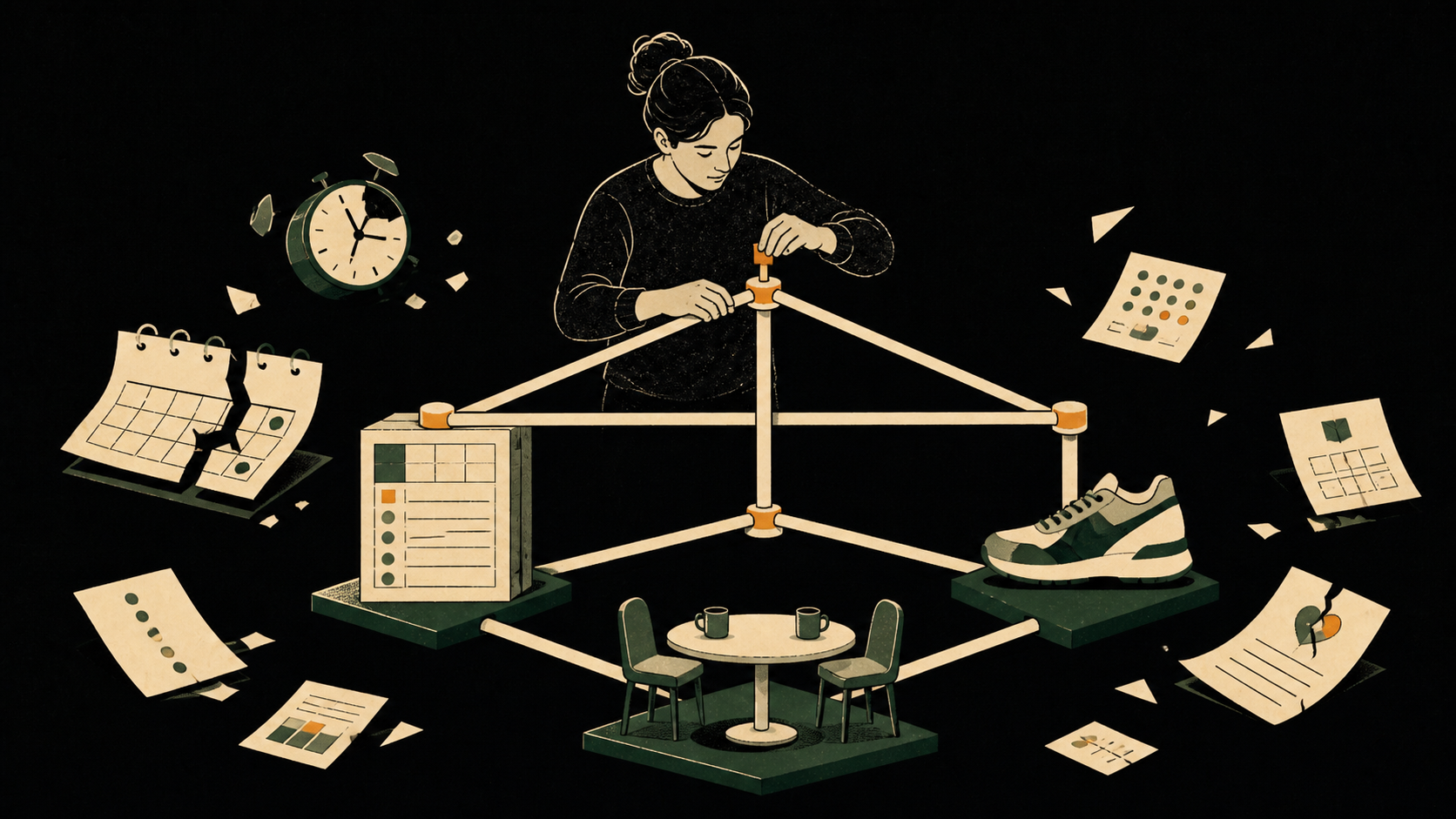
Every piece of advice you'll read about getting through separation tells you to build a routine. Wake up at the same time. Exercise in the morning. Meal prep on Sundays. Meditate. Journal. Do the ten habits of people who've rebuilt their lives.
It's not wrong, exactly. Routine helps. The problem is what happens the first time a kid gets sick at 2am, or work explodes for a week, or you get a letter from a lawyer on a Tuesday and you can't think clearly for three days. Routines collapse under load. The more brittle the structure, the harder the fall when it breaks — and in the first year of separation, it will break regularly.
What you need instead isn't a routine. It's a structure. The difference matters.
Routine versus structure
A routine is a sequence. You do this, then this, then this, at these times, in this order. It works when the conditions are stable. A structure is a scaffold — the fixed points your week hangs off, not the detailed sequence of how you spend every hour.
Think of it this way. A routine says: gym at 6am, meditation at 6:45, deep work from 7 until 9. A structure says: I exercise three times a week, I track my spending once a week, I call one person I care about every few days. The routine breaks the first time you sleep through your alarm or the kids need you at 6am. The structure bends. The commitments still happen — just on different days, in different windows, in whatever form works that week.
This is not a minor distinction. In stable life, routines are efficient. In chaotic life — and the first year of separation is chaotic life — routines are a source of failure. Every broken routine is evidence that you can't hold it together. Structure gives you something that can flex without collapsing.
Three anchors
A structure needs anchors. Not ten habits. Not a wellness stack. Three things.
One financial anchor. One physical anchor. One social anchor.
Financial: Something you do every week with money. Review your spending. Transfer a fixed amount to an emergency fund. Pay something off. The action doesn't have to be large — the consistency matters more than the amount. The goal is to stay oriented financially during a period when financial anxiety is high and financial attention is scattered.
Physical: Something you do with your body at least three times a week. Running, gym, swimming, sport — whatever you'll actually do. Physical commitment during separation isn't about fitness. It's about having something that requires you to show up and that returns a predictable reward. Sleep improves. Anxiety reduces. Decision-making clears. The physiology is straightforward. Pick something you don't have to talk yourself into.
Social: One real conversation per week. Not texting. Not social media. A phone call, a coffee, a run with someone. Pick someone who can handle directness — you don't need a support group, you need someone who will talk normally to you about normal things and occasionally ask how the separation is actually going. One person is enough. More is fine. Zero is a problem.
Three anchors, held seriously, beats ten commitments held loosely. The research on habit formation says the same thing — fewer, stronger commitments outperform complex stacks. The practical reality of separation confirms it. You don't have the cognitive bandwidth for ten things right now. Three is a number you can protect.
Use Atlas Goals tool to choose one anchor for this week instead of trying to rebuild your whole life at once.
The two-week test
Here's how you know if a structure is working: does it survive two bad weeks?
Pick your three anchors. Hold them for a fortnight. Week one is usually manageable. Week two is where reality hits — something goes wrong at work, the kids are sick, a legal conversation derails a Tuesday. If you can still find the physical commitment and the financial check-in and one real conversation even in that week — imperfectly, at different times than planned, but still — the structure holds. Keep it.
If it collapses entirely in week two, it's too complex. Simplify. Not "this didn't work, I need more discipline" — that's the wrong lesson. The right lesson is: a structure that breaks under ordinary pressure isn't a structure. Remove something, or make the remaining anchors smaller and more durable.
Most people in early separation try to do too much and then blame themselves when it falls apart. Habit research generally supports the same broad idea: simple, repeatable commitments are more durable than complex behaviour stacks. The answer is almost never more effort. It's a simpler structure, held properly.
If your structure keeps collapsing around the kids, the Kids Week guide is the next practical read.
What structure actually does
Structure isn't about productivity. It isn't about becoming a better person or building your post-separation identity or proving something to yourself or anyone else.
It's about staying operational during a period when you are, by definition, running on reduced capacity. The point of a financial anchor isn't to become financially sophisticated. It's to make sure you're not surprised by the state of your money. The point of a physical anchor isn't peak fitness. It's sleep quality and a cleared head. The point of a social anchor isn't a support network. It's one person who knows how you're actually going.
A structure is what lets you fall apart on a Tuesday — properly fall apart, sit with it, not function — and still turn up on Wednesday. Not because you've recovered. Because the scaffold held, and there's enough shape to the week that Wednesday happens anyway.
That's all it needs to do right now. Not thrive. Function.
Pick three anchors this week. Write them down. Run the two-week test. That's it.