Quick answer
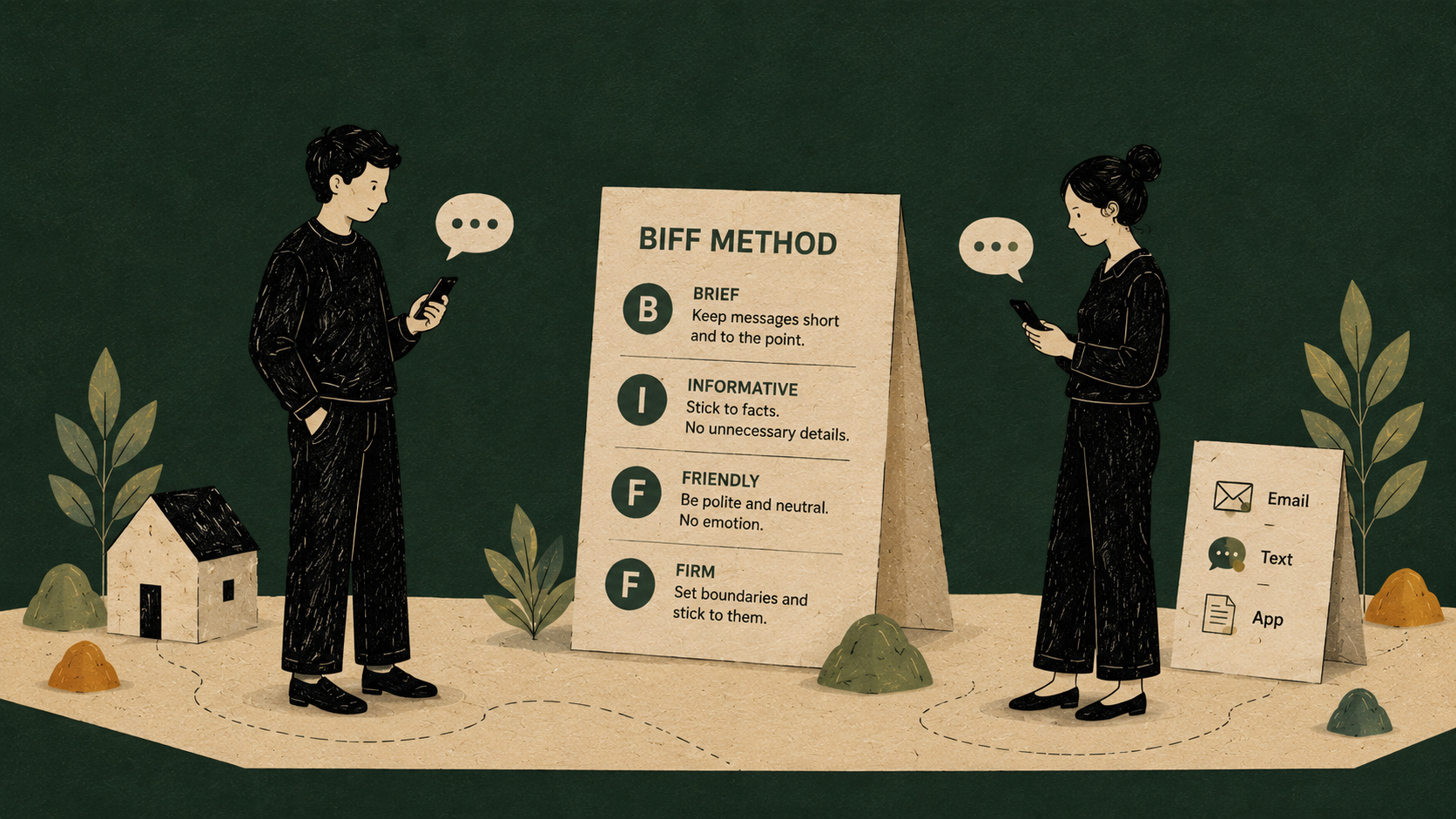
BIFF is a communication method commonly associated with Bill Eddy and the High Conflict Institute. It means:
- Brief: short enough to remove fuel.
- Informative: facts, not character analysis.
- Friendly: civil, not warm.
- Firm: clear ending, clear next step.
Use it when communication with your ex is tense, circular or bait-heavy.
The message that wants a fight
It arrives at 9.17pm.
Three paragraphs. Two accusations. One historical subplot. A screenshot from 2021.
Your body wants to respond to every point. That is how you lose the evening.
The BIFF method gives you a fence.
For the broader low-trust co-parenting framework, read co-parenting when you don’t trust your ex.
The BIFF filter
Before sending, ask four questions:
- Is it brief?
- Is it informative?
- Is it friendly enough to be read by a third party?
- Is it firm enough to end the loop?
Not soft. Not passive. Just clean.
Example: school pickup
Bad reply:
“You always do this. I told you three times I have a meeting and you never listen.”
BIFF reply:
“I can do pickup on Tuesday at 3.15pm. I cannot do Wednesday this week. Please confirm by 5pm today so I can tell after-school care if needed.”
The second version gives information and a deadline. It does not invite a documentary.
Example: accusation
Incoming:
“You are selfish and the kids are upset because you keep changing everything.”
BIFF reply:
“I understand the change is hard for them. The current arrangement is Monday and Tuesday with me, Wednesday and Thursday with you, and alternate weekends. I’ll keep following that unless we both agree to a change in writing.”
No defence speech. No counterattack.
When to document instead of respond
Some messages do not need a reply. They need a record.
Use Atlas Admin to keep a factual record of communication that is relevant to kids or legal matters.
Document:
- missed handovers
- changed agreements
- threats
- refusal to communicate about children
- school or medical decisions
- money agreements
- breaches of orders or plans
Do not document every rude adjective. Court does not need your ex’s complete literary catalogue.
Email, text or co-parenting app?
Text is fast but messy.
Email is slower and better for decisions.
Co-parenting apps can help if communication needs structure, timestamps and fewer disappearing threads.
The tool matters less than the rule: one topic per message.
Common mistakes
Replying to the tone
Tone is bait. Reply to the parenting issue.
Over-explaining
Long messages create more handles for the other person to grab.
Being fake friendly
“Hope you’re well” can sound deranged when you both know nobody is well. Civil is enough.
Making threats
Do not write “my lawyer will destroy you.” Write the practical next step.
The practical next step
Before your next reply, draft it. Cut it by half. Remove one accusation. Add one deadline or clear next action.
Then send the boring version.
Sources and resources
Last checked: 20 May 2026.
This article is general information, not legal, financial or medical advice. Check the current rules before acting on anything money, court or health related. If there is family violence, coercive control, risk to children, urgent housing risk or court orders in place, get professional advice before relying on a checklist.