Quick answer
After separation, the main Australian Government payments to check are:
- Family Tax Benefit: help with the cost of raising children.
- Parenting Payment: income support if you are the principal carer of a child and meet the income, assets, residence and care rules. Services Australia currently says single parents generally need to be principal carer of a child under 14, while partnered parents generally need to be principal carer of a child under 6.
- Child support: assessed separately, but it can affect Family Tax Benefit Part A.
- Rent Assistance: may be available if you receive an eligible payment and pay rent.
- Advance payments: may be available if you already receive an eligible payment, but they are repaid from future payments.
- Crisis Payment: not a general separation payment. It only applies in specific extreme circumstances and severe financial hardship, such as family and domestic violence or other qualifying extreme circumstances. Strict contact and claim timing can apply, so check the current Services Australia rules immediately.
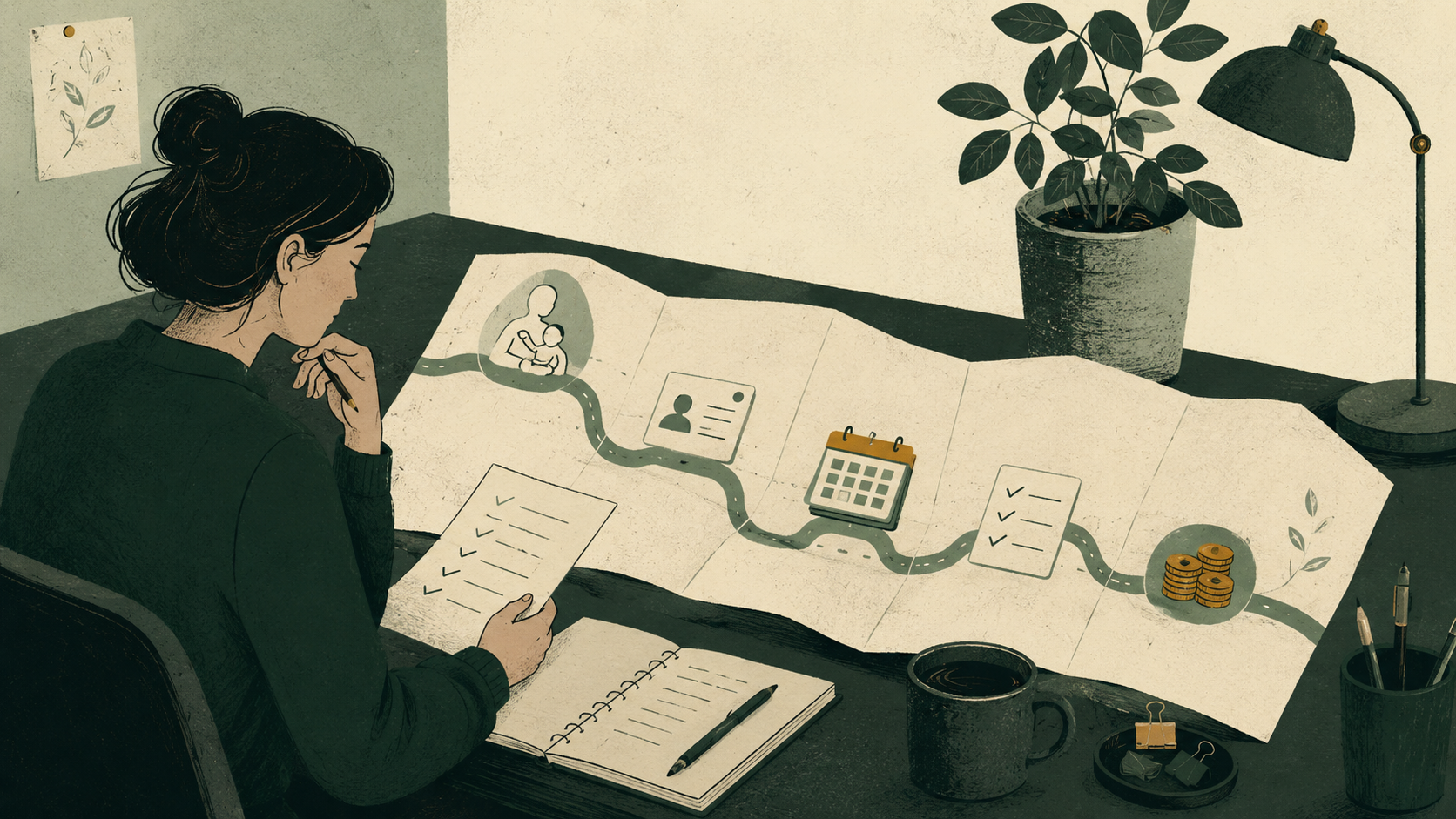
The order is simple: go to Centrelink and update your relationship status, update care percentages, check Parenting Payment eligibility, check any child support action you need to take, then put the expected money into your real monthly budget.
The form pile starts quickly
You separate on a Monday.
By Wednesday someone tells you to call Centrelink. Someone else says child support will affect Family Tax Benefit. Someone else says not to claim anything until the care percentage is sorted.
Nobody says which door to open first.
Start with myGov and Services Australia. You are not trying to master the welfare system. You are trying to make the next month visible.
What Family Tax Benefit is
Family Tax Benefit is a payment to help with the cost of raising children. It has two parts:
- FTB Part A: paid per child, affected by family income and maintenance action.
- FTB Part B: extra help for some single-parent families and some single-income couple families.
For separated parents, the important details are usually:
- your care percentage
- your income estimate
- whether child support has been assessed or privately arranged
- whether you have taken reasonable action to obtain child support where required
If child support is part of the picture, read what child support actually costs you next. Then use the Atlas CSA estimator to sketch the number before you build your budget.
What Parenting Payment is
Parenting Payment is different. It is income support for the principal carer of a child if you meet the income, assets, residence and care rules. Services Australia currently says single parents generally need to be principal carer of a child under 14. If you have a partner, the child-under-6 threshold generally applies.
As at the current Services Australia guidance, single parents generally need to be the principal carer of a child under 14. Partnered parents generally have a younger child threshold.
Do not guess this one from a Facebook comment. Check Services Australia and apply the current test to your situation.
What to do first
1. Link Centrelink to myGov
If you have not used Centrelink before, this is the annoying doorway. Do it anyway.
You will usually need identity documents, bank details, income information and details about your children and care arrangements.
2. Update your relationship status
If you have separated, Services Australia needs to know. If you are separated but still living under one roof, Services Australia may also ask for a separated-under-one-roof form so they can assess whether to pay you as single or partnered. That form is not the same as reporting the separation itself. Read Separated under one roof when that is the mess you are in.
3. Update care arrangements
Care percentage matters.
It can affect child support and family assistance. Write down the actual nights, not the emotional version of the argument.
Example:
- Parent A: Monday and Tuesday every week, alternate Friday to Sunday.
- Parent B: Wednesday and Thursday every week, alternate Friday to Sunday.
That is a pattern. Convert it into nights.
4. Check child support
Child support and Family Tax Benefit talk to each other. The system does not care that the conversation with your ex is painful. It cares what has been assessed, collected or privately arranged.
If you receive Family Tax Benefit Part A and the other parent is expected to provide child support, Services Australia may require you to take reasonable maintenance action. The maintenance action grace period can be 91 days from events such as separation, a child entering your care, your care increasing to 35% or more, or you first becoming eligible to apply for child support. Do not let that deadline sit in the junk drawer.
5. Build the first survival budget
Once you have a rough payment estimate, put it into Atlas Finances. Put rent, mortgage, food, transport, school, insurance, debt and child support beside it.
The question is not whether the payment feels fair.
The question is whether the month works.
Common mistakes
Mistake 1: assuming 50/50 care means no support
Child support does not work that simply. Income, care percentage and the cost of children all matter.
Mistake 2: delaying because the arrangement is not final
Most arrangements are not final at the start. Update what is real now, then update again when it changes.
Mistake 3: forgetting rent assistance
If you are renting and receiving an eligible payment, check whether Rent Assistance applies. It is often assessed when you claim an eligible payment or update your rent details, but do not assume it has been counted until you have checked your Services Australia record. Do not leave that number outside the spreadsheet.
Mistake 4: treating Centrelink as shameful
Boring answer: it is a public system. Use it if the rules say you can. The first year after separation is expensive enough without performing pride for an empty room.
A simple claim checklist
Write this down before you start:
- myGov login working
- Centrelink linked
- Medicare details current
- tax file number accessible
- bank account in your name
- income estimate
- rent or mortgage amount
- children’s Medicare details
- care pattern by nights
- child support status
- separation date
- evidence if living under one roof
Then claim what applies.
Start with the official rules. Then put the number into the month.
Sources and resources
Last checked: 20 May 2026.
This article is general information for separated parents in Australia. It is not legal, financial, housing, employment or medical advice. Payment rules, court processes and service eligibility change. Check the current official rules before acting, and get professional advice where safety, court orders, family violence, housing risk, debt, health or children’s welfare are involved.
- https://www.servicesaustralia.gov.au/family-tax-benefit
- https://www.servicesaustralia.gov.au/parenting-payment
- https://www.servicesaustralia.gov.au/learning-about-child-support
- https://www.servicesaustralia.gov.au/basic-child-support-formula?context=21911
- https://www.servicesaustralia.gov.au/how-your-percentage-care-affects-your-child-support-payments?context=21911
- https://www.servicesaustralia.gov.au/mod-s
- https://www.servicesaustralia.gov.au/ss293
- https://www.servicesaustralia.gov.au/advance-payment
- https://www.servicesaustralia.gov.au/crisis-payment
- https://www.servicesaustralia.gov.au/crisis-payment-for-extreme-circumstances-family-and-domestic-violence
- https://www.servicesaustralia.gov.au/why-you-need-to-apply-for-child-support-while-you-get-ftb-part?context=22151
- https://www.servicesaustralia.gov.au/income-test-for-family-tax-benefit-part?context=22151
- https://www.servicesaustralia.gov.au/who-can-get-parenting-payment?context=22196