There's no version of this conversation that feels right. You can prepare for it, think carefully about the words, choose the right moment — and it's still one of the hardest things you'll do as a parent. That's normal. The goal isn't to make it easy. The goal is to make it clear, calm, and not something your children have to manage for you.
Most parents I've spoken to either said too much or not enough. Too much because the silence felt unbearable and they filled it. Not enough because they were afraid of the reaction and retreated early. Both leave children without what they actually need: a short, honest explanation and a clear sense that their life is going to be okay.
This is a practical guide. It won't make the conversation easy, but it will give you a structure that works.
Before you say anything: the non-negotiables
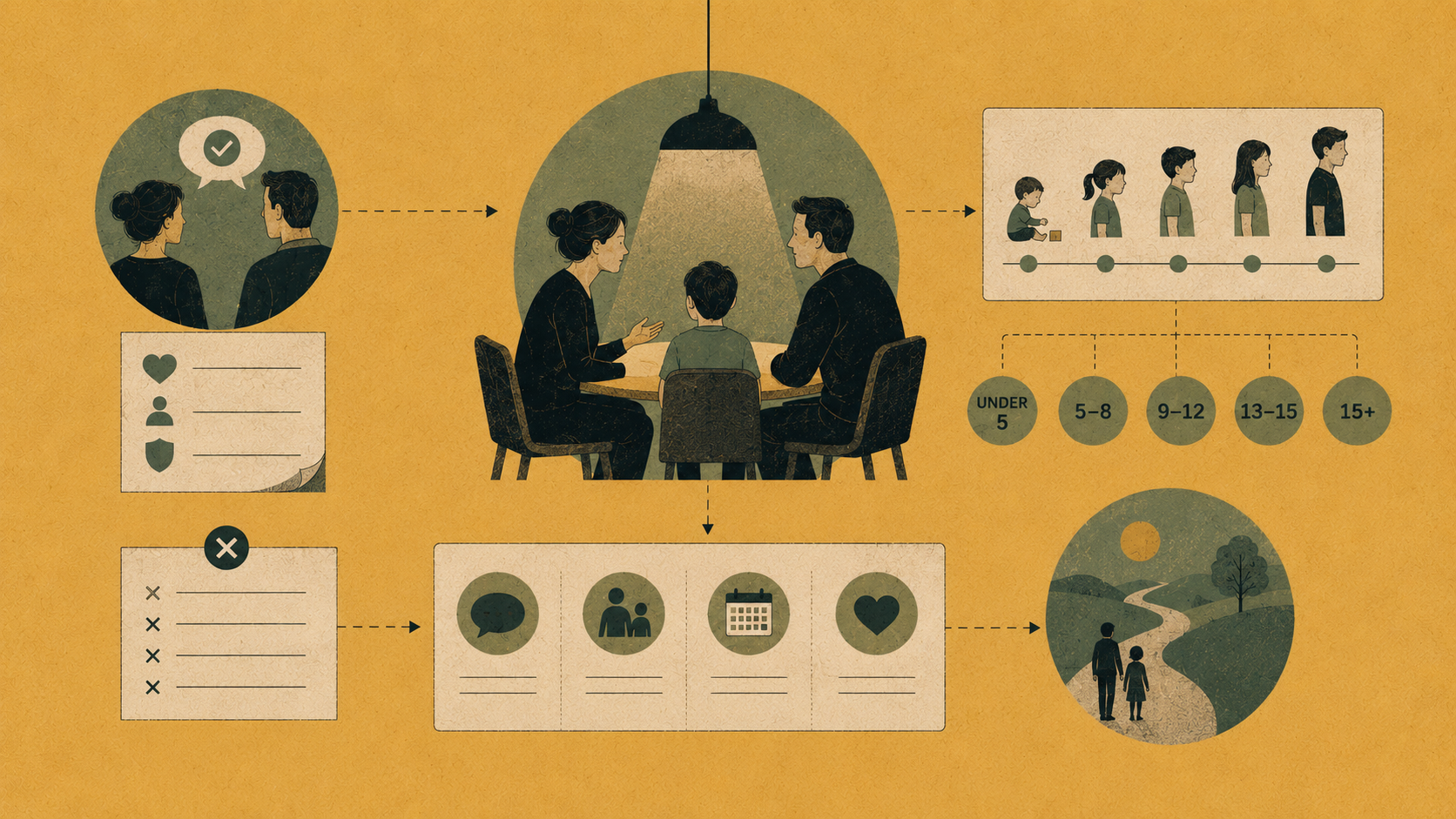
Tell them together. Both parents, same room, same conversation. If at all possible — regardless of how things are between you — do this as a joint message. A child who hears different things from different parents at different times is a child who is now managing conflict as well as loss. Do the one hard thing together.
Agree on the words beforehand. Not a script you read aloud — an agreement between you and your ex on the key messages. What you're saying, what you're not saying, what questions will be answered and how. This takes a conversation between the two of you first, ideally more than one.
Don't tell them before you have to. If the move is three months away, telling the children in week one means three months of sustained anxiety for them with no resolution. Tell them when the situation is clear enough that you can answer their immediate questions. "We're separating and this is what it will look like" is a better conversation than "We might be separating and we're not sure what happens next."
What to actually say
Short. Not a lecture, not an explanation of the relationship's breakdown, not an apology that goes on for ten minutes. Children need the core facts and the reassurance. Everything else is for you, not for them.
Something like this:
"We have something important to tell you. Mum and Dad have decided we're not going to live together anymore. We're going to separate. That means [parent] is going to live [at the apartment / at Grandma's / at the new house in [suburb]]. You're still going to spend lots of time with both of us. You're still going to go to [school]. This isn't because of anything you did, and it isn't something you can fix. We both love you, and that is never going to change."
The specific words will be yours. But the structure should include all of these elements:
- The plain statement of what is happening
- The practical shape of what it looks like for them (where they'll live, what stays the same)
- The explicit statement that it isn't their fault
- The explicit statement that both parents love them and that won't change
You do not need to explain why. You do not need to assign blame. You do not need to give them the adult context. Children don't need to understand your marriage. They need to understand their life.
Age-by-age: what to adjust
Children process this differently at different ages. Not different core messages — the same basic facts — but different follow-through and different reactions to expect.
Under 5. Concepts are concrete, not abstract. Focus entirely on the physical reality: where they'll sleep, who will pick them up from childcare, whether the dog is coming. Expect repetition of the same questions over many days. Answer them the same way each time without frustration. Emotional attachment to routine is high — protect the routine as much as possible.
5 to 10. Old enough to understand that something significant has changed, but limited emotional vocabulary to process it. Watch for behavioural changes rather than verbal processing: clinginess, sleep disruption, regression, acting out, or withdrawal. Reassure through actions as much as words. Check in regularly but don't push them to talk if they don't want to. Let them know it's always okay to ask questions.
10 to 14. More aware of the adult context, likely already picking up on tension. They may have opinions about the living arrangement. They may feel loyal to one parent over the other. Acknowledge their feelings without giving them decision-making power over the arrangements. Don't ask them to choose sides, carry messages, or manage either parent's emotional state. Be honest that it's hard, but don't make them your support person.
15 and over. Near-adult processing capacity but still a child in the household. They may have strong opinions about custody arrangements. They deserve more information than younger children but not the full adult narrative — there's a difference between honest and burdening. Respect their existing relationships and social lives. The separation disrupts their independence as much as their security.
What not to say
Do not say anything that puts the other parent in a negative light. Even if it's true. Even if they deserve it. Your children are half that person, and criticising their other parent is, at some level, a message about them. It also puts them in an impossible position. Every negative thing you say about your ex goes into a bank account your child carries. That account earns interest in ways you won't see for years.
Do not say "we both love you" and then demonstrate through your behaviour that this is a conflict in which they need to take sides. Children are very good at reading the gap between what adults say and what adults do.
Do not tell them before your practical arrangements are clear. "We're not sure where anyone is living yet" is a sentence that will haunt a child for weeks.
Do not use your children to gather information about your ex's life. They will know what you're doing, even if they can't articulate it.
Do not ask them to keep the news secret from grandparents or close family members. That's asking them to carry weight they shouldn't carry.
After the conversation
Expect the unexpected. Some children cry immediately. Some go quiet. Some say "okay" and ask if they can go back to their video game. The reaction in the room is not a reliable measure of how they're processing it. Check in a few days later, casually, with something like: "How are you going with everything we talked about?" Don't force a second conversation, but leave the door clearly open.
Tell the school. You don't need to share detail — a quiet word to the class teacher that there's a significant change happening at home allows the school to watch out for changes in behaviour or wellbeing without putting the child in the position of having to explain.
Keep the routine as stable as you can for the first month. School pickups, bedtimes, activities, meals. The content of the routine matters less than its consistency. What children are really asking when they're anxious is: is my life going to be okay? A functioning routine is the most concrete answer you can give.
After the conversation, use Atlas Kids Week tool to make the next fortnight visible: handovers, meals, school gear, and the simple rhythm they can rely on.
One more thing
The conversation you're dreading is smaller, in the long run, than the quality of the co-parenting relationship that follows it. Children recover from family structures changing. They don't recover as well from years of watching their parents treat each other with contempt.
The words today matter. The years after matter more.
If you need to turn the agreement into something workable, read the parenting plans guide next.
Sources and further reading
- Raising Children Network — telling children about separation: raisingchildren.net.au
- Australian Institute of Family Studies — children and separation: aifs.gov.au
- Beyond Blue — helping children cope with family change: beyondblue.org.au
- Family Relationship Advice Line (FRAL) — 1800 050 321, free advice for parents navigating separation and its effect on children