Most parenting plans fail not because the parents couldn't agree in principle, but because the document didn't cover the details that actually cause friction. They're written in a spirit of optimism — everyone is getting along well enough to agree on a plan, the big questions are answered, and it feels like the hard part is done.
Then six months later, someone's partner doesn't want to rearrange Christmas, there's a disagreement about which school the child attends, one parent moves forty minutes away, and the plan that worked on paper stops working in practice.
This is a guide to building a parenting plan that holds up — not just in the easy months, but in the ones where things get complicated.
What a parenting plan is (and what it isn't)
A parenting plan is a written agreement between two parents about how they'll raise their children after separation. It's not a court order. It's not automatically enforceable. Under Australian family law, a parenting plan can be used as evidence of what both parties agreed to, but it doesn't carry the same weight as consent orders.
If you want your parenting arrangements to be legally enforceable, you need consent orders made by the Family Court. The consent orders process is not as expensive or complicated as it sounds for straightforward arrangements — most can be submitted without a court hearing, and many are handled through a solicitor or a family dispute resolution service.
That said, a parenting plan that works — where both parties are committed to it and understand what it requires — is often better than rigid court orders that don't quite fit the situation. The goal is an agreement both parents can actually follow and adapt when necessary.
Whether you formalise it as consent orders or operate on a plan, the content below applies equally.
The core structure: what needs to be covered
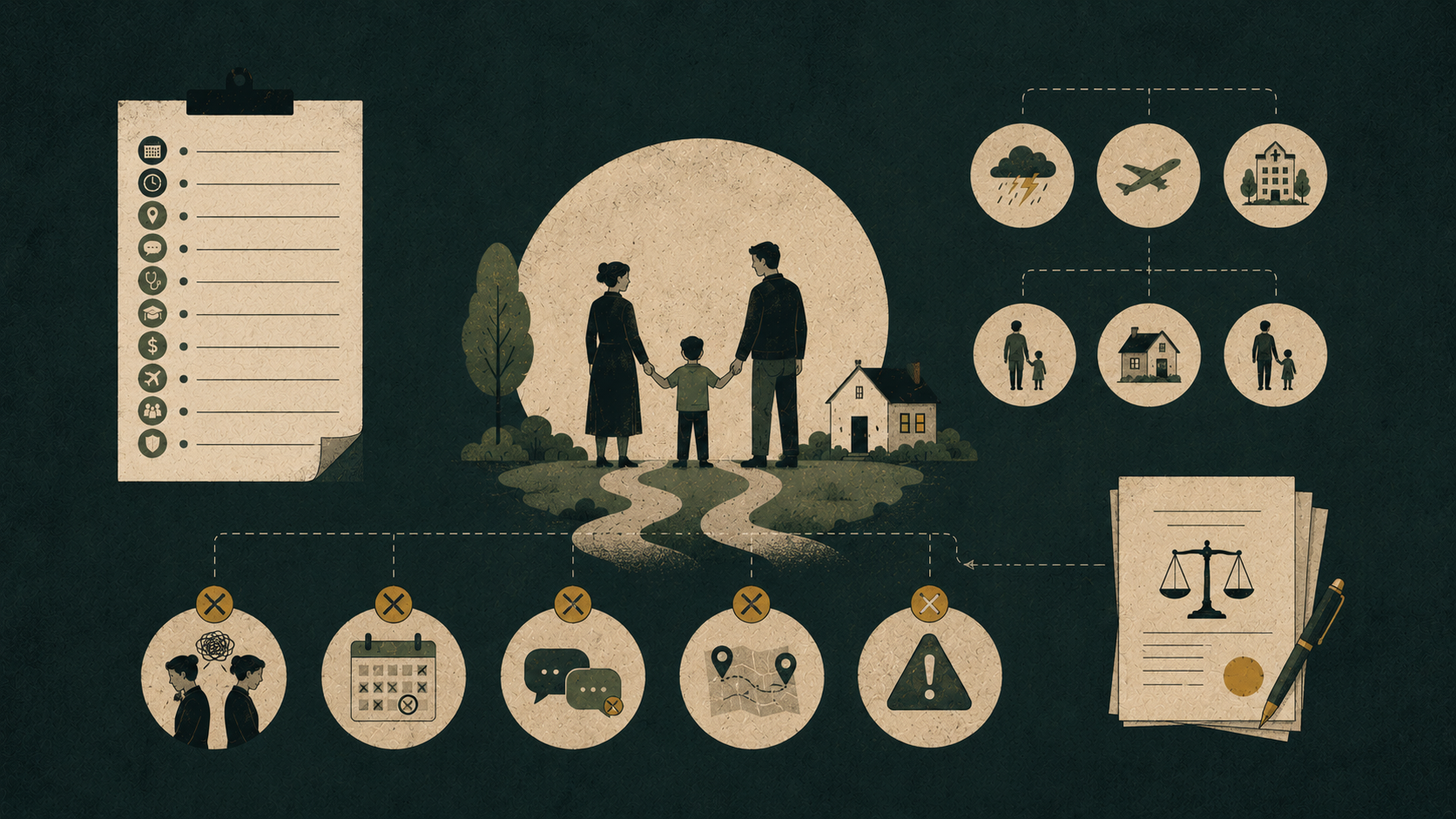
A plan that lacks detail in any of these areas will eventually cause conflict in that area.
Living arrangements. Which parent is the primary residence? What is the time split? Be specific: the days, the handover times, and the handover location. "Alternate weekends" is not specific enough. "Every second Friday at 5pm from school pickup, returning Sunday at 6pm to the primary residence" is specific.
School holidays. Most term-based schedules break down during school holidays because the plan didn't account for them. How are school holidays divided? Is it based on weeks, or specific breaks? Who handles the January holiday period? How far in advance do plans need to be communicated?
Public holidays. Christmas Day, Easter, Anzac Day, Melbourne Cup Day if you're in Victoria — which parent has the children on which public holidays, and does that change year to year? The most common source of unnecessary conflict is Christmas. Write it down in advance, specifically.
Special occasions. Birthdays — the children's, the parents', extended family events. Mother's Day and Father's Day. Graduations. What's the arrangement for the child's birthday if it falls on the other parent's time?
Handover. Where does it happen? Who does the transport? What happens if one parent is running late? Is there a grace period before an absence is treated as a breach? Most conflict at changeover is caused by an absence of rules about changeover.
Communication during the other parent's time. Can the child call the other parent? How often? At what times? What's the process if the child is distressed and asks to call?
Medical decisions. Who takes the child to regular appointments? Who holds the Medicare card? How are emergency decisions handled if one parent can't be reached? What happens if one parent wants a specific treatment and the other disagrees?
Education decisions. Which school the child attends, what year, what stream, whether they do tutoring, whether they change schools. Both parents should be on the school's communication list and have access to reports, teacher meetings, and school events regardless of which parent they're primarily with.
Extracurricular activities. Who pays for and transports children to activities? What happens if an activity falls during the other parent's time? Can a new activity be enrolled in unilaterally, or does it require agreement?
Travel and holidays away. Domestic travel — how much notice is required? International travel — who holds the passport? What consent is required for the other parent to take the children overseas? This is a significant legal question: taking a child overseas without the other parent's consent is a serious matter under Australian law.
New partners. When and how new partners are introduced to the children, and whether prior notice to the other parent is expected. This is contentious and many plans avoid it — but having nothing documented doesn't make it easier when it happens.
Communication between parents. Which platform, what response timeline for non-urgent matters, and what counts as urgent. Written communication (email or a co-parenting app) is preferable to phone calls for most parents — it reduces conflict, creates a record, and allows both parties to compose responses without emotional escalation.
Build the practical version of the plan in Atlas Kids Week tool: actual days, handover rules, school events, meals, and notes.
The scenarios most plans miss
What happens if a parent needs to relocate? This is one of the highest-conflict situations in family law. If there's any possibility of relocation — for work, for a new relationship, for family support — your plan should have something in it, even if it's just a process for how that conversation happens and what notice is required.
What happens if a parent is unwell or incapacitated? Who looks after the children if one parent is in hospital? Who is the emergency contact?
What happens if the children don't want to go? Older children particularly may resist handover. The plan can't force a teenager — but it should have a clear position so both parents are responding consistently rather than using the child's preference as leverage against each other.
What happens if one parent is consistently late or absent? What's the process? What counts as a missed visit? Is there a catch-up provision, or does missed time simply fall away?
What breaks plans
Most parenting plans don't fail because they were poorly written — they fail because one or both parents start treating the plan as a maximum rather than a minimum. Every provision becomes a boundary to defend rather than a baseline to work from.
The plans that hold up are the ones with one additional element that no document can supply: a working communication system between two parents who disagree on many things but share a commitment to not making their children navigate the disagreement.
If that doesn't describe your situation, consent orders and a family dispute resolution service matter more than the quality of the parenting plan text.
If trust is low, read the low-trust co-parenting guide before relying on informal flexibility.
Getting it formalised
Once you have an agreed parenting plan, formalising it as consent orders provides enforceability. The process involves:
Drafting the orders — usually with a family lawyer or through a community legal centre.
Filing them with the Federal Circuit and Family Court through the Commonwealth Courts Portal.
The court reviewing and making the orders without a hearing, in most straightforward cases.
If you can't reach agreement, the Family Dispute Resolution process (mediation) is generally required before you can apply to the court for parenting orders. The mediator can assist in producing a plan that's then formalised.
Legal Aid services in most states can assist with consent orders for parents who meet income thresholds.
Sources and further reading
- Federal Circuit and Family Court — parenting orders and consent orders: fcfcoa.gov.au
- Family Relationships Online — parenting plans and templates: familyrelationships.gov.au
- Legal Aid — parenting agreements (search "[your state] legal aid parenting plan")
- Raising Children Network — parenting after separation: raisingchildren.net.au
- OurFamilyWizard — co-parenting communication app widely used in Australia: ourfamilywizard.com