You get the obvious stuff right. Separate bank accounts, dividing the mortgage, who pays what until settlement. Most people sort that in the first week. It's the things nobody thinks to mention that do the damage — the slow leaks, the compounding mistakes, the assets quietly in the wrong place.
This is that list. Seven things. All of them cost money if you miss them, and none of them are on the checklist your lawyer sent you.
1. Superannuation
Super is usually the biggest asset in a separation and the one most likely to be left on the table. People negotiate hard over the house and then treat super as an afterthought.
It's not. Super can be split between partners as part of a family law property settlement. The split doesn't trigger tax — it's a rollover, not a withdrawal. If your ex has significantly more super than you (or vice versa), a super split can rebalance the settlement in a way that makes the house less important. Many couples don't realise this is available until after they've already finalised.
Get financial or tax advice before you sign anything significant. Some advice fees may be deductible depending on what the advice relates to — ask the adviser upfront rather than assuming. The mistake of not getting advice is always more expensive than the fee.
2. Joint credit cards
Most people close the joint accounts. They miss the credit cards — specifically, the ones where only one person knew the limit was $18,000, and only one person was using it.
Two problems. First, any debt on a joint card is joint debt, regardless of who spent it. If your ex runs up $6,000 on a card you're both on and doesn't pay it, the lender comes to you. Second, a cancelled or overdrawn joint card damages both credit scores, which will matter when you try to refinance a mortgage or get a car loan on a single income.
Check every card. Get yourself removed from anything you're not the primary holder of. If you're both primary holders, either clear and close it or get it refinanced into one name. Then pull your credit report — yours, not a joint one — and read it.
3. Auto-renewing subscriptions
This one sounds small. It adds up.
Shared subscriptions are designed to be forgotten. Spotify Family. Apple One. YouTube Premium. Broadband in both names. A gym you haven't been to since winter. A streaming service the kids watch on both devices. Some of these charge annually — which means you might not notice for another eight months.
Sit down with your bank statement and go back three months. Mark anything recurring. Anything shared, cancel or transfer. This isn't about saving $30 a month — it's about cutting the threads. Every shared subscription is a small ongoing connection to someone you're trying to separate from cleanly.
4. Tax and benefits position
Your tax and benefit situation changes the day you separate, and most people don't adjust until July.
Don't assume there's a simple "single parent tax offset" waiting for you. What usually matters is updating your relationship status and care arrangements with Services Australia, checking your Child Care Subsidy eligibility, reviewing Family Tax Benefit, and making sure your employer withholding still fits your new situation.
Child care subsidy rates change based on income and care arrangements. Services Australia will want to know about the separation. If you're on a combined assessment and haven't told them, you're likely on the wrong rate.
Child support is not taxable income for the person receiving it, and it isn't tax deductible for the person paying it. But it can affect Services Australia calculations — including Family Tax Benefit assessments — so don't leave it until tax time to understand how it interacts with the rest of your position. A tax accountant familiar with family law situations is worth an hour of your time before your first post-separation return.
5. Insurance beneficiaries
Your life insurance, income protection, and superannuation death benefit probably still list your ex as beneficiary.
This is the one people find out about at the worst possible moment. A super fund pays the death benefit to whoever is nominated — and if you haven't updated the nomination since you married, that's your ex. The fund has discretion in some cases, but not always. The cost of updating it is fifteen minutes and a form. The cost of not updating it is your kids' inheritance going somewhere else.
Check every policy. Life, TPD, income protection, trauma. Update the nominations. Do this week, not when you get around to it.
6. The real cost of two households
Most separated people underestimate what it actually costs to run two homes.
When you were together, you split costs implicitly — one mortgage, one electricity account, one set of cleaning products, one lawn mower. Now you're each running a full household on incomes that haven't changed. The gap between what you earned and what one household costs was manageable. The gap between what you earn and what two households cost is different.
Sit down and total it up: rent or mortgage, utilities, food, transport, kids' costs at your place, subscriptions, insurance, savings rate. Compare it to your income. Most people find a gap they weren't expecting in the first few months — which is the worst time to find it.
Do this early, with real numbers, not estimates. Atlas has a budget tool built for exactly this split — two-household view, one income. Use it, or use a spreadsheet. Either way, see the actual number before the bank does.
Put these costs into the Atlas Finances tool so you can see what your new month actually looks like.
7. Child support: what the formula actually does
Most people think child support is negotiated. It isn't — unless you make a private agreement, it's calculated. Services Australia applies a formula based on both parents' incomes, the number of nights each parent has the children, and the ages of the children.
The number the formula produces is often very different from what either parent expected. Higher earners are frequently surprised by how much they're assessed to pay. Lower earners are frequently surprised by how little they receive.
The formula also doesn't cover everything. School fees, medical costs, extracurricular activities — those are outside the standard assessment and need to be negotiated separately. If you reach a private agreement, get it registered with Services Australia so it's enforceable.
Use the child support estimator on the Services Australia website before any financial conversations. Know your number before you sit down.
If child support is one of the unknowns, use the child support calculator in the Atlas Finances tool before you make big decisions.
What this adds up to
None of these are dramatic. They're admin. But admin left undone becomes financial exposure — and financial exposure is the last thing you need in the first twelve months of separation.
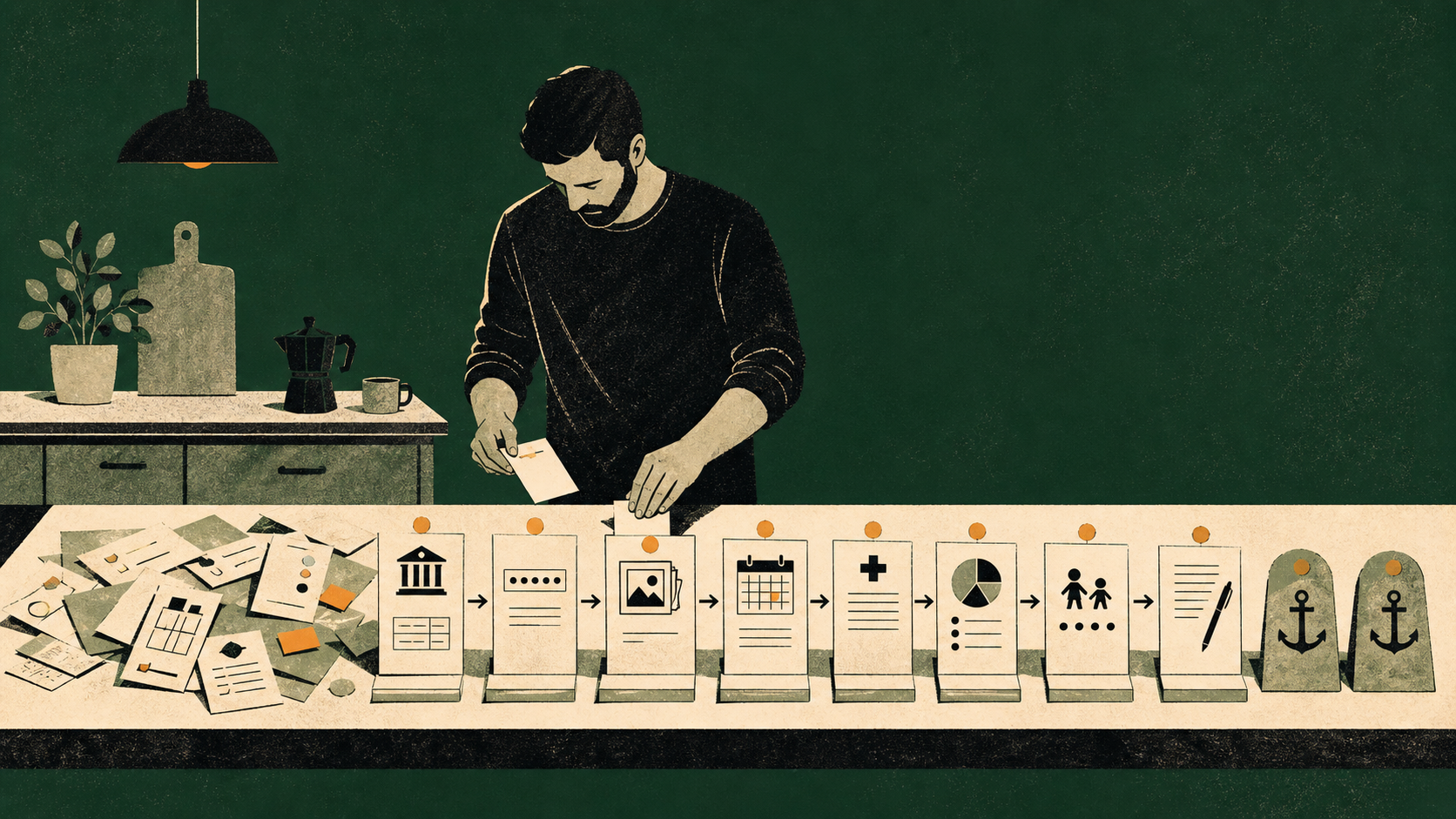
Super split, credit cards, subscriptions, tax position, insurance nominations, two-household budget, child support calculation. Seven things. None of them take more than a few hours to sort. The Atlas budget calculator covers the household side — put your real numbers in and see where you actually stand. The rest needs a financial adviser and a Saturday afternoon.
Do the list. Then close the tabs.